I haven’t been thinking much about marketing recently, beyond vague bafflement at adverts showing on bar and gym TVs that only flash up the logo for the last seconds, and adverts for AI companies on the tube that have no obvious audience and so maybe are just to remind investors that they exist, and the fact that one of the bus routes near me has ditched most of the useful contents of its digital displays so it can promote some TfL slogan that will be forgotten in a fortnight anyway.
Okay, I’ve been thinking about marketing quite a lot. But as a consumer, not as a practitioner. And why would I? I’m not working as a marketing practitioner right now.
So it was perhaps surprising, but more likely just a window into my strange mind (don’t peek for too long, it’s probably illegal under the Crime and Policing Act 2026), that I keep on coming back to how dreadful a metaphor the marketing funnel is.
We all know the marketing funnel (or the purchase funnel or similar): it starts wide at the top, then gets narrower as you move through successive stages. This is a common enough representation, created by BronHiggs and available on Wikimedia, with stages of awareness, interest, desire, and action.


Visually it’s kind of okay, I guess. It gets across the point that you have more people who are aware of your product than people who are interested in buying it soon, which itself is likely to be more folk than actually will buy it soon. You can use it as a visualisation when analysing your sales and marketing data, although this choice of visualisation means that the value for each stage is the width or height of the start of the stage, and then the stage gets narrower to meet the next stage. You have to ignore the area, which means absolutely nothing, which is typically a bad idea in visualisations. You can use a Sankey diagram instead, which also allows you to show what happens to the people who drop off, and any in-bound sources to the middle and lower stages.
But that’s the visualisation. The marketing funnel is supposed to be a model. That means that the funnel should be a metaphor for what is going on. But this isn’t how funnels work. This bugs me.
If you poured all the people who make up your addressable market into an actual funnel, they’d all come out the bottom. Don’t do this, most people don’t like it unless it’s at a water park.
Now I’m probably not going to find something that a funnel is a good metaphor for in marketing, because that would involve ignoring and denying people’s autonomy, and they generally don’t like that either, at least when they notice.
I’m highly unlikely to find a better metaphor, so I haven’t bothered trying. But I can come up with bad metaphors really easily. This is what I’ve managed so far. I’ve constrained myself to kitchen tools and gadgets.
The Marketing Sieve

Photo by the United States Marine Corps, on Wikimedia

Pour an audience segment into the sieve, shake it carefully to sift, and they come out as individual people-grains.
Use this metaphor because:
Segments don’t buy cola, people do. Forgetting that we’re marketing to individual people is easy to do when you can just buy against a segment in a DSP or social media platform. Even if you think in terms of segments, the actual marketing effects and resultant sales are at the level of the individual.
If a key component of your sales journey is in-person, then you can manage some of those marketing effects. The door to a shop is a sieve, turning passing foot traffic into individuals who might buy something. Hand-selling books is a big thing, for instance (although it’s most valuable when there are others in the shop to overhear, as noted in this article about marketing and selling books).
Don’t use this metaphor because:
- It isn’t actually a metaphor for marketing work. The door is the sieve. Opening a page in a magazine is the sieve. Clicking on a YouTube thumbnail is a sieve. These are actions taken by the consumer, not by the marketer.
The Marketing Pasta maker

Photo by Magic Madzik, on Wikimedia

Feed in your addressable market, and get audience fettucce or audience linguine or whatever shape your machine supports.
Use this metaphor because:
It reminds us that when we slice audiences they may look similar but each has their own peculiarities, hard to detect but which affect their cooking time. If you’re segmenting an audience, this is kind of obvious, but if you are slicing an audience for A/B testing or some other randomised experiment then understanding which inconsistencies are relevant to your experiment is critical. (This is why geo-based tests generally need to have usefully comparable geos defining the different samples.)
Even after you slice up your audience, you still have to cook it, which I guess here means actually running some marketing activity, and eat it, which means selling more units. It’s surprising how many conversations with marketers have to be brought back to selling things.
Don’t use this metaphor because:
- Hand on heart, have you ever used a pasta maker and been happy with the result? So why would you want that as a metaphor for the work you do? Unless your client is Barilla, maybe.
The Marketing Dish Mop
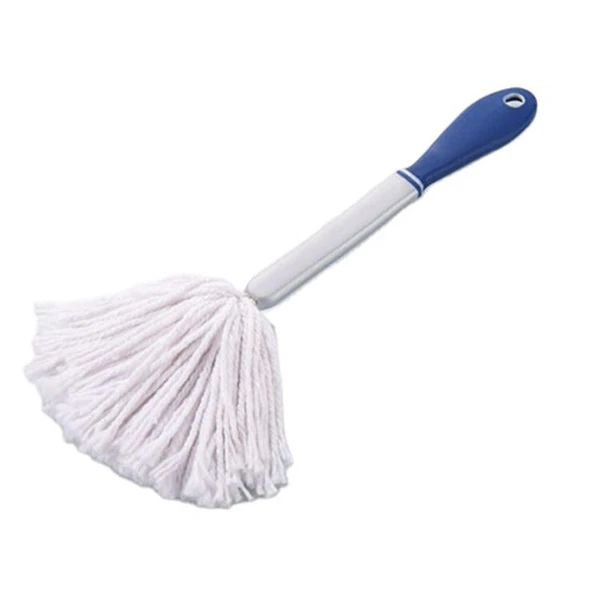
Promotional photo from Sciedco, a Canadian scientific equipment store because apparently people don’t take photos of dish mops these days
Not a scourer or a brush, a proper mop, like in Stella Gibbons. The plate is the population who aren’t going to buy from you, food stuck to the plate is people you think might if you put in a bit of effort.
Use this metaphor because:
You need detergent to shift stains. Detergent here is spend, probably. You also need to scrub: spend often isn’t enough.
With enough time and effort you can get every last possible consumer. You’ll feel good about it until your boss asks you why you’ve taken so long to build a media plan when there’s a machine that will do most of the work.
Don’t use this metaphor because:
- If you don’t have a machine, it’s probably easier to keep using the clettering stick.
The Marketing Whisk

Photo by Sylt90 and Hohum, on Wikimedia

Take a bunch of different people and blend them together to prepare them for your marketing activity.
Use this metaphor because:
Like eggs and cream, people are easier if you remove inconsistencies, or at least ignore them once you’ve worked for a bit and got tired. Do you really need that many segments? Maybe you can whisk a few of them together again.
This is the perfect time to add spices or other flavourings. When you’re beating your image of consumers to an equal and fluffy consistency, think: can I make them more interesting? What if we assumed all 30-49 year old professionals were interested in ghosts?
Don’t use this metaphor because:
- Like batter, you must be careful not to overwork this metaphor.
The Marketing Tea Strainer

Photo by Meganbeckett27, on Wikimedia

Pour your addressable market in the top, and whatever flows out the bottom are your customers. Everyone else is compostable.
Use this metaphor because:
It reminds you that you are leaving space for people to advance to a deeper relationship with your product or brand. And, like tea, the best relationships need time to develop.
You can also think of this the other way round, where what is left in the strainer is what is valuable. This evokes panning for gold, which acknowledges a more active role for marketing than just pouring people’s attention in the top of the funnel.
Don’t use this metaphor because:
- It sounds silly.
What next?
Much as I’d like to keep this going for another fifty household objects (you won’t believe my ideas for the Marketing Butter Knife or the Marketing Bread Bin, and that’s before we even get out of the kitchen), I probably should do something less daft.
Being serious for a minute though, the metaphors we choose to use are important. They shape our understanding of a problem, and of the solution space we’re operating in. Sometimes, picking the wrong metaphor can literally prevent you from succeeding. More commonly, a metaphor will reduce the amount of innovative thinking people do beyond its implicit bounds. The metaphor is a box. Think beyond the box. But also, don’t think of the metaphor as a box, because that itself is a metaphor.